The Sikhote-Alin Meteorite
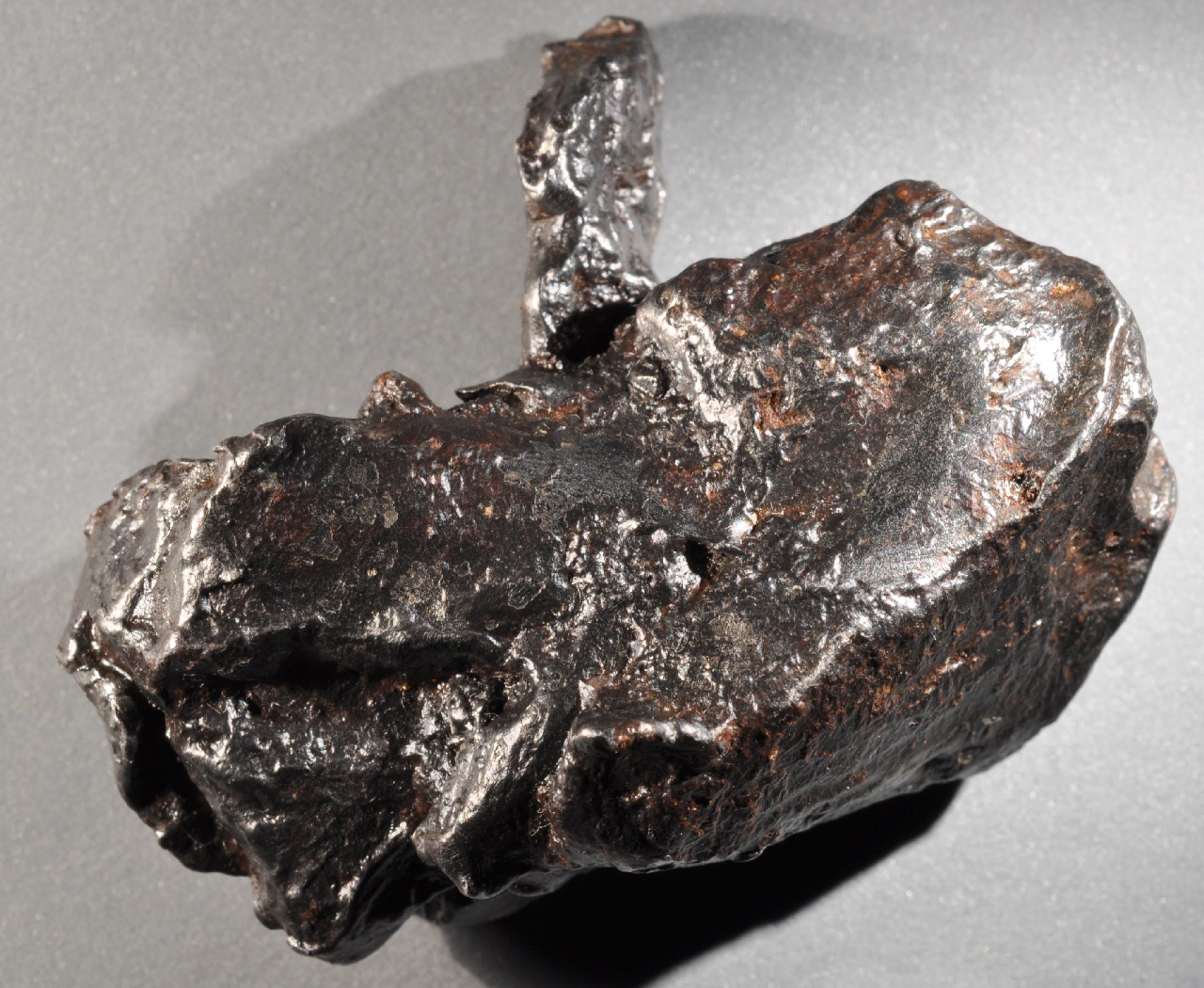
A 137.5gm piece of the iron Sikhote-Alin Meteorite (about the size of a tennis ball).
This is of course only a small metoerite, and its impact left only a small mark on the earth's surface. Had this been a much, much larger
meteor, it would have blasted peices of the earth up into the sky, some to fall back again, some into interplanetary space!
The Sikhote-Alin iron meteorite fell during daylight at 10:38 a.m. local time on February 12, 1947.
Witnesses reported a fireball that was brighter than the sun.
It came from out of the north, about 15 degrees east of north and descended at an angle of 41 degrees.
It left a trail of smoke and dust that was 20 miles long and lingered for several hours.
Light and sound of the fall were observed for two hundred miles around the point of impact.
The speed of entry was estimated to be 14.5 kilometers per second.
This is about 8.7 miles per second or 31,000 miles per hour.
As the meteorite entered the atmosphere some of it began to break apart. The group of fragments fell together.
When the descending group of meteorites reached an altitude of about 3.5 miles, the largest mass apparently broke up in a violent explosion.
This was a very low altitude for such an event.
The fragments scattered over an elliptical area of about a half a square mile.
The largest fragments made small craters and pits. One of these measured 85 feet across and 20 feet deep.
The larger craters are located at the far end of the strewn field.
Sikhote-Alin is one of the most spectacular falls of recorded history and one of a very small number of recent iron meteorite falls.
The total mass of the Sikhote-Alin has been estimated at somewhat under 1000 tons.
Of course this was spread over the area of the strewn field.
The largest fragment is a 1,745 kilogram specimen now on display in Moscow.
A larger number of specimens range from 1000 kg on down.
back to main page