A especially fantastic class of meteorite: the Pallasites, jewels from space!

A cabochon cut from the Brahin Pallasite.
The crystals are peridot, which are usually cracked due to the impact of the meteorite when it struck the earth.
The peridot are held in place by a structural matrix of iron mixed with nickel.
Mixing nickle (and select other metals) with iron in exact proportions produces stainless steel!
Pallasites are formed at the boundary of the melted metal core and the outer "rock" mantle (or covering)
of an asteroid hundreds of km in diameter. This is the size needed to be large enough to have
enough gravity to allow the iron to melt and collect at the core. This heat would have
melted the rock layers of the mantle. As the core cooled, the melted mantle rocks crystalized,
and some of these crystals formed these dense peridot crystals. These dense crystals settled at the boundary between the cooling iron core and
the mantle where the two would be intermixed, and this is what you would see where they meet.
One more event would still be required: this asteroid needed to be shattered by some major event, likely a direct
hit by another meteor, and the pieces of both scattered into space.
Eventually some of these iron-peridot boundary pieces would fall to the earth!
These are sliced and polished samples, which show the extra-terrestrial beauty of the trapped peridot crystals!
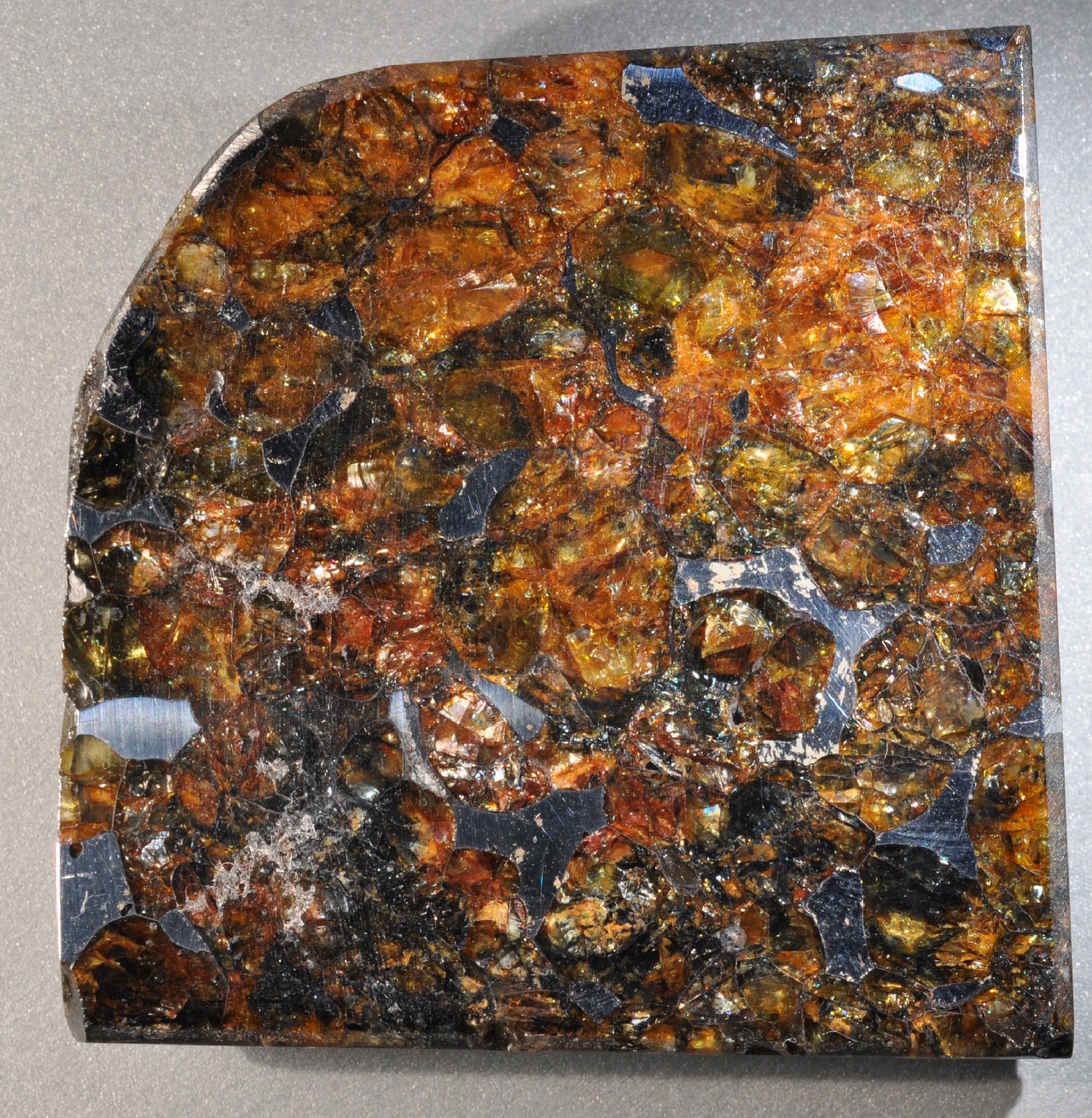
A 58.75gm slice of the Seymchan Pallasite.
The main mass of this meteorite contained so much iron-only mass that it was cataloged in with the Iron meteorites.
But it also had a small section of peridot in it, and so is usually referred to as a Pallasite.
Pallasites vary in colour from pale yellow-green to dark brown.
Wikipedia's concise description of Pallasites.
The Brahin Pallasite in the Meteorological Society's database.
The Seymchan Pallasite in the Meteorological Society's database.
back to main page